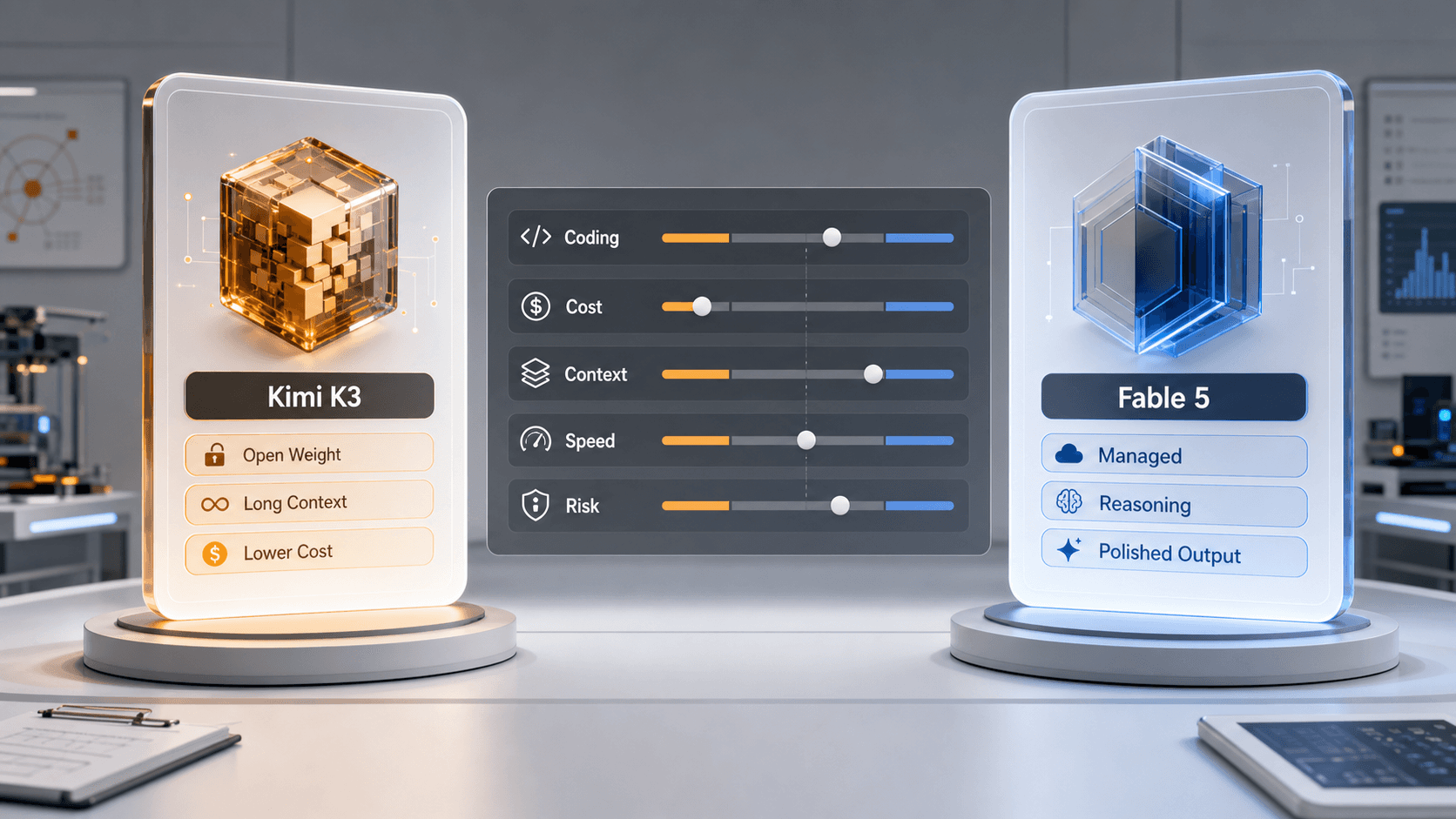
Kimi K3 vs Fable 5 is not a simple winner-takes-all comparison. Kimi K3 is the model to test first when you care about cost, open-weight access, long context, and coding experiments. Fable 5 is the safer default when you want a managed premium model with stronger enterprise fit and fewer deployment decisions.
The practical answer is to choose by workload. If your task is a coding agent, long repository analysis, or cost-sensitive API workflow, start with Kimi K3. If the task is high-value reasoning, customer-facing automation, or a managed Anthropic workflow, test Fable 5 as the baseline.
Part 1: Compare Kimi K3 and Fable 5 by Decision Factor
Start with the decision, not the benchmark headline. A benchmark screenshot can be useful, but it will not tell you whether the model is right for your latency target, budget, context size, data policy, or production retry rate.
Where Kimi K3 Has the Stronger Case
Choose Kimi K3 when the comparison is about lowering cost, testing an open-weight model, pushing long-context input, or running many coding trials. It is especially attractive when the work can tolerate slower responses in exchange for cheaper experiments or more flexible deployment paths.
Where Fable 5 Has the Stronger Case
Choose Fable 5 when the job is high-value, customer-facing, or tied to Anthropic-style managed access. It is also the better baseline when you need strong general reasoning, polished writing, safer default behavior, and less infrastructure work.
Part 2: Test Kimi K3 and Fable 5 Before Switching
Do not compare the models with different prompts. Use the same task, same context, same temperature, same scoring rubric, and the same retry rule. Otherwise you are comparing your prompt setup more than the models.
AI Prompt for Model Comparison
Use this fixed prompt to compare Kimi K3 and Fable 5 on the same task without copying your private test details.
Evaluate the same task across two AI models.
Score each model for correctness, reasoning quality, coding reliability, latency, cost, context use, and recovery after feedback.
Return a comparison table first, then a recommendation for which model should handle this workload in production.
Separate confirmed results from subjective judgment.
- - Paste the same task, document, code sample, or benchmark prompt for both models.
- - Add your cost limit, latency target, retry policy, and output format.
- - Run at least one short task and one realistic production-style task.
- 1. Pick three tasks: one coding task, one long-context task, and one general reasoning task.
- 2. Keep settings consistent: use the same temperature, context, tools, and output requirements.
- 3. Track cost and latency: record input tokens, output tokens, total time, retries, and failed runs.
- 4. Score recovery: ask each model to fix one mistake after feedback and check whether the second answer improves.
Use OpenRouter for a Fast First Comparison
If both models are available in your provider layer, OpenRouter is a convenient first pass because you can keep the API pattern similar while changing the model ID. For setup details, use the Kimi K3 OpenRouter guide. For broader Kimi specs and access notes, use the Kimi K3 model profile.
What Not to Conclude Too Early
Do not call Kimi K3 better only because it is cheaper, and do not call Fable 5 better only because it is more polished. The better model is the one that gives your workflow the best mix of correctness, speed, cost, context handling, and operational risk.
Conclusion: Pick the Model by Workload
For most builders, Kimi K3 is the better first experiment when cost, open-weight access, and long-context coding matter. Fable 5 is the better baseline when you need a premium managed model for high-value reasoning or customer-facing workflows. Test both on the same tasks before moving production traffic.